

From the Knowledge Base
Practical thinking for founders and organizational leaders navigating growth, financing, strategy, operations and change.
AI is everywhere in business conversations right now.
But many leaders are asking the wrong question.
It’s not:
“What AI tools should we use?”
It’s:
“How do we scale without eroding judgment, culture, and trust?”
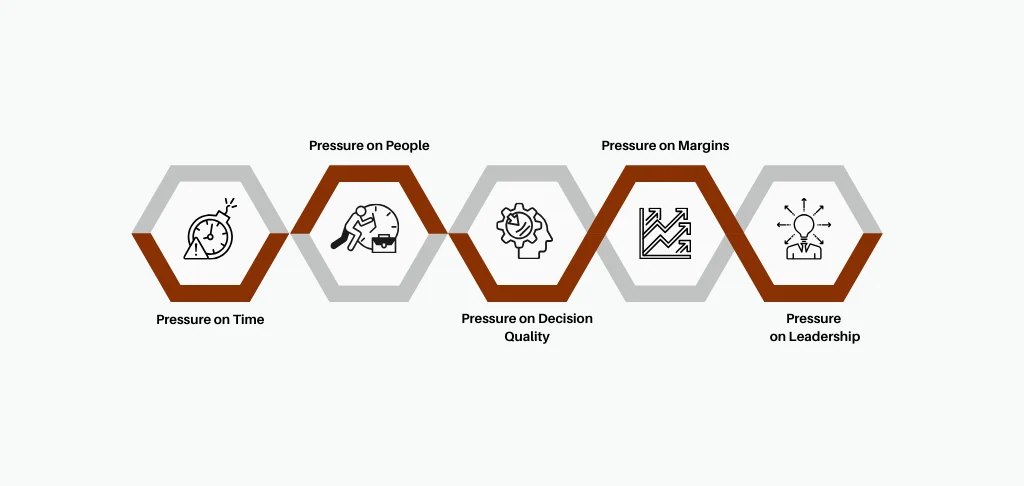
Because scale has always created pressure:
-
Pressure on time
-
Pressure on people
-
Pressure on decision quality
-
Pressure on margins
-
Pressure on leadership capacity
AI does not solve these pressures automatically. But used intentionally, it can remove friction so leaders can focus on what only humans can do. Here are five core ways AI helps businesses scale…when led well.
1. AI Scales Strategic Clarity

As businesses grow, complexity multiplies faster than revenue.
More customers.
More data.
More decisions.
More uncertainty.
AI can synthesize vast amounts of information, surface patterns, model scenarios, and stress-test assumptions. It can help leaders:
-
Run “what-if” scenarios before committing capital
-
Analyze market trends faster
-
Identify operational blind spots
-
Surface second-order consequences
But here’s the critical distinction:
AI can inform decisions. It cannot own them.
Strategic clarity still requires human judgment, ethical reasoning, risk tolerance, and accountability.
“When leaders use AI as a thinking partner rather than a decision-maker, they increase the speed and depth of insight without outsourcing responsibility.”
Used well, AI becomes an instrument panel not the pilot.
2. AI Scales Operational Capacity

Most scaling failures are not vision failures. They are system failures.
Founders often compensate for broken systems by:
-
Working longer hours
-
Hiring prematurely
-
Micromanaging
-
Absorbing complexity personally
AI changes this dynamic.
Automation tools, workflow integrations, and AI-supported process systems allow businesses to:
-
Eliminate repetitive tasks
-
Reduce manual errors
-
Standardize quality
-
Increase output without immediate headcount expansion
This is where AI becomes a true multiplier.
But the leadership principle remains clear:
Humans design the system. AI runs it.
“If leaders automate chaos, they simply scale chaos. If they design clean systems first, AI becomes a force for coherence.”
3. AI Scales Customer Reach and Growth

Growth creates tension between personalization and volume.
Historically, businesses had to choose:
- High touch and small scale
or - Large scale and low intimacy
AI narrows that gap. Used strategically, it can:
-
Analyze customer behavior patterns
-
Improve lead qualification
-
Personalize communication at scale
-
Surface sales insights from conversation data
-
Improve conversion efficiency
This doesn’t mean AI replaces relationship-building. It removes friction between interest and trust.
The result?
-
Faster response times
-
More relevant engagement
-
Better-informed sales conversations
-
More consistent messaging
Growth becomes more intentional, not more chaotic.
4. AI Scales Financial Visibility and Risk Awareness

One of the most dangerous moments in scaling is when growth accelerates, but financial clarity lags behind.
Cash flow risk increases.
Forecasting becomes harder.
Margins fluctuate.
Decision cycles compress.
AI-powered financial tools now help businesses:
-
Automate bookkeeping and categorization
-
Model runway scenarios
-
Identify spending anomalies
-
Predict revenue fluctuations
-
Stress-test expansion plans
This gives leaders something invaluable: foresight.
Scaling becomes less reactive and more intentional.
Instead of flying blind into growth, founders gain insight into risks before they become crises.
Reminder: AI does not eliminate uncertainty, but it will increase visibility.
The courage to act still belongs to the leader.
5. AI Scales Learning and Adaptation

The fastest-scaling companies are not those with perfect plans.
They are the ones who learn fastest.
AI accelerates learning cycles by:
-
Detecting patterns in customer behavior
-
Surfacing employee engagement trends
-
Identifying performance inconsistencies
-
Synthesizing feedback across teams
Instead of waiting for quarterly reviews or lagging indicators, leaders gain continuous signals.
This creates a powerful advantage:
-
Faster iteration
-
Earlier course correction
-
Reduced blind spots
-
More adaptive strategy
But there is a leadership caveat:
AI can reveal patterns and surface insight.
Only leaders can change behavior.
If leaders ignore what they see, AI becomes noise.
If leaders remain open, AI becomes
That’s Assisted Intelligence.
Our two cents:
AI does not replace leadership.
It reveals it.
Good leaders scale faster.
Weak leadership becomes visible sooner.
The businesses that thrive in the AI era will not be the ones with the most tools.
They will be the ones with the clearest boundaries:
-
AI handles repetition.
-
Humans handle responsibility.
-
AI surfaces patterns.
-
Humans interpret meaning.
-
AI increases speed.
-
Humans protect integrity.
Scaling Without Losing Your Soul

The true opportunity of AI is not efficiency alone.
It is capacity building.
Capacity for:
-
Better decisions
-
Stronger systems
-
Faster learning
-
Deeper focus
-
More courageous leadership
When used with clarity, AI does not erode culture; it protects it.
It does not replace leaders; it strengthens them.
It does not remove uncertainty; it helps leaders navigate it with greater awareness.
The future of scale is not Human or AI.
It is Human + AI with leadership firmly at the center.
Leadership in the Age of AI
At L&P, we view AI as part of a broader leadership evolution.
We call it Assisted Intelligence not because AI replaces human capability, but because it can strengthen it when guided well.
Our Human + AI Leadership Framework was developed to help founders and executive teams answer critical questions:
-
What must remain human-owned as we scale?
-
Where does automation increase clarity, and where does it create risk?
-
How do we protect judgment, culture, and accountability as systems evolve?
-
Is leadership capacity expanding at the same rate as technology adoption?
AI will continue to accelerate. The real differentiator will not be access to tools, it will be the maturity of the leaders and teams using them.
If you are scaling your business and navigating AI adoption, the most important investment is not the software. It is clarity about priorities, processes, and where you want to grow.
We work with founders, executive teams, and boards to strengthen decision-making, governance, and culture as complexity increases.
You can begin by:
Requesting our Human + AI Founder Self-Assessment or reaching out to start a leadership strategy conversation. Because sustainable growth is not built on efficiency alone. It’s built on leaders who remain fully human even as their capabilities expand.